What travel actually does to your brain and how to perform through it
Major Takeaways
- Travel induces immediate physiological stress, including reduced oxygen levels, dehydration, and circadian disruption, that directly impairs executive function, memory, and concentration.
- Long-haul flights offer a unique "distraction vacuum" that can drastically boost deep focus and creative thinking, provided you proactively manage the physical stress of flying.
- Maintaining a structured, consistent routine using targeted adaptogens and microdosed melatonin helps stabilize cognitive performance and accelerates jet lag recovery on the ground.

13-Minute Read
The traveler's complete guide to mental performance before, during, and after any trip.
Most people optimize everything about travel except the one thing that determines how useful they are when they arrive: their brain.
You research the best seats. You pack light. You download shows for the flight. And then you land in a fog, spend the first day fighting your own biology, and waste the very hours you traveled so far to use.
This isn't a willpower problem. It's a physiology problem. Travel, even under the best conditions, is one of the most cognitively disruptive experiences you can put your body through. Understanding why is the first step to actually doing something about it.
Here's everything you need to know about what travel does to your mental performance, and how to protect it from the moment you leave home to the moment you hit the ground running.
The Cognitive Load Starts Before You Even Board
People think jet lag begins at the destination. In reality, cognitive degradation starts the night before you fly.
Pre-travel anxiety is nearly universal; the mental checklist that never fully quiets down, the 5am alarm that means you can't fully commit to sleep, the low-level cortisol spike that keeps you in a state of readiness your brain can't shake. Studies show that even mild sleep restriction, losing 60–90 minutes versus your normal night, measurably reduces attention, working memory, and processing speed the next day.
Then there's the airport itself. Navigating terminals, managing security lines, tracking gates, making micro-decisions about food and timing; all of it draws on the same prefrontal cortex resources you need to be sharp at your destination. Decision fatigue is real, and it accumulates fast in environments designed for throughput, not human comfort.
By the time you board, many travelers are already behind. The flight is just the next chapter.
This is where having a stable mental performance foundation matters. Ingredients like Ashwagandha, an adaptogen with clinical evidence for reducing cortisol and supporting the body's stress response; and Rhodiola Rosea, which has been studied for reducing both mental and physical fatigue under stress, are doing real work before you ever reach 35,000 feet. Magic Mind Original is built around this kind of resilience support, not just an energy spike to get you out the door.

What Flying Actually Does to Your Brain
The in-flight experience is more physiologically hostile than it looks. Here's what's happening at altitude.
Reduced Oxygen Availability
Commercial aircraft cabins are pressurized to an equivalent altitude of roughly 6,000 to 8,000 feet above sea level. At that pressure, blood oxygen saturation drops measurably compared to sea level. The brain is extremely sensitive to oxygen availability; even small reductions can dull alertness, slow cognitive processing, and reduce your capacity for sustained attention. It's not in your head. It's in the air.
Dehydration and Its Cognitive Consequences
Humidity in airplane cabins typically hovers below 20%, far lower than what the human body operates comfortably in. You lose water faster than you realize, and most travelers don't compensate adequately. The cognitive effects of even mild dehydration, as little as 1–2% of body weight in fluid loss, include reduced short-term memory, impaired concentration, and increased perception of effort for mental tasks. A two-hour flight can get you there. A ten-hour transatlantic crossing makes it much worse.
Circadian Disruption
Crossing time zones doesn't just make you tired. It desynchronizes the biological clocks embedded in nearly every organ in your body, including the brain. Your sleep-wake cycle, body temperature curve, cortisol rhythm, and cognitive performance windows are all calibrated to the time zone you left. At your destination, they're running on the wrong schedule. This is jet lag, and it affects far more than how sleepy you feel.
Sleep Architecture at Altitude
Even when you do sleep on a plane, the quality is compromised. Cabin noise, altitude, reduced oxygen, and the inability to reach deep positions all suppress slow-wave and REM sleep; the two stages most critical for memory consolidation, emotional regulation, and cognitive recovery. You may sleep for six hours on a red-eye and wake up feeling like you barely rested, because physiologically, you barely did.
Sensory Overload and Decision Fatigue
The ambient noise of a plane cabin sits around 85 decibels, well above comfortable conversation level. Your nervous system is continuously processing that noise even when you're not consciously registering it. Add the unpredictability of turbulence, seat changes, meal service interruptions, and the general unpredictability of travel, and you're looking at a sustained low-grade cognitive load that wears down your reserves across a long flight.
The Upside of Being Trapped at 35,000 Feet: Why Planes Are Secretly Productivity Powerhouses
Here’s the thing nobody tells you alongside all the warnings about cabin pressure and circadian disruption: for a lot of people, a long-haul flight is their single most productive window of the entire trip. Maybe of the entire week.
That sounds contradictory. You just read four sections about how flight degrades cognition. Both things are true and understanding why is what separates people who arrive having accomplished something from people who arrive having watched four episodes of a show they didn’t even want to watch.
The Distraction Vacuum
Modern cognitive science has a name for what derails deep work on the ground: interruption cost. Every time you context-switch: an email notification, a Slack ping, a colleague stopping by, your brain doesn’t just pause. It needs anywhere from 15 to 25 minutes to fully re-engage with complex thinking. Most knowledge workers never actually get there. They’re permanently in the shallow end of their own attention.
A plane strips all of that away by force. There’s no inbox you can meaningfully act on at 38,000 feet. No one can schedule an impromptu meeting. The person next to you, hopefully, is asleep. For a few hours, the only thing demanding your attention is whatever you choose to put in front of you. That enforced singleness of focus is rarer and more valuable than most people realize until they’re in it.
Why Creativity Specifically Gets a Boost
Creativity doesn’t thrive on urgency. It thrives on what researchers call “idle time,” mental space where the brain isn’t executing tasks but is instead free to make unexpected connections. This is the cognitive state that produces the shower ideas, the walk-in-the-park breakthroughs, the solutions that arrive when you stop trying to force them.
Flights, especially long-haul ones, create this state almost accidentally. There’s a point on any flight past four or five hours where you’ve exhausted the obvious distractions and find yourself just… thinking. Staring at the seat-back in front of you with a half-written document open and something forming. That isn’t boredom. That’s your default mode network doing exactly what it’s designed to do.
The physical fact of being in motion also matters. There’s a well-documented relationship between movement and cognitive fluency; not just exercise, but the sensation of moving through space. The brain in transit is a brain in a particular kind of openness. It’s why some of the most frequently reported “a-ha” moments in creative history happened during long journeys rather than at a desk.
The Paradox: Stress and Flow Require the Same Preparation
Here’s the catch: the same physiological stressors that we described: dehydration, reduced oxygen, cabin noise, disrupted cortisol rhythms, are also the things that can prevent you from accessing this productive state. The window of in-flight focus is real, but it’s fragile. It requires a brain that isn’t fighting too hard just to stay baseline functional.
This is where intentional support changes the equation. A traveler who boards well-hydrated, with cortisol already managed by adaptogens, with a nootropic stack keeping their prefrontal cortex properly resourced; that traveler gets to use the distraction vacuum as an asset. The traveler who boards depleted just experiences the noise and the cramped seat and the fog.
The best flights aren’t the ones where you survive. They’re the ones where you land having written something, solved something, or figured out something you’d been circling for weeks. That outcome is available on almost every long-haul flight, if you set yourself up for it.
The In-Flight Performance Protocol: How to Use Magic Mind on a Long-Haul Flight
Knowing what's working against you makes it easier to build a deliberate protocol around it. Timing matters as much as what you take.

The Sleep Window
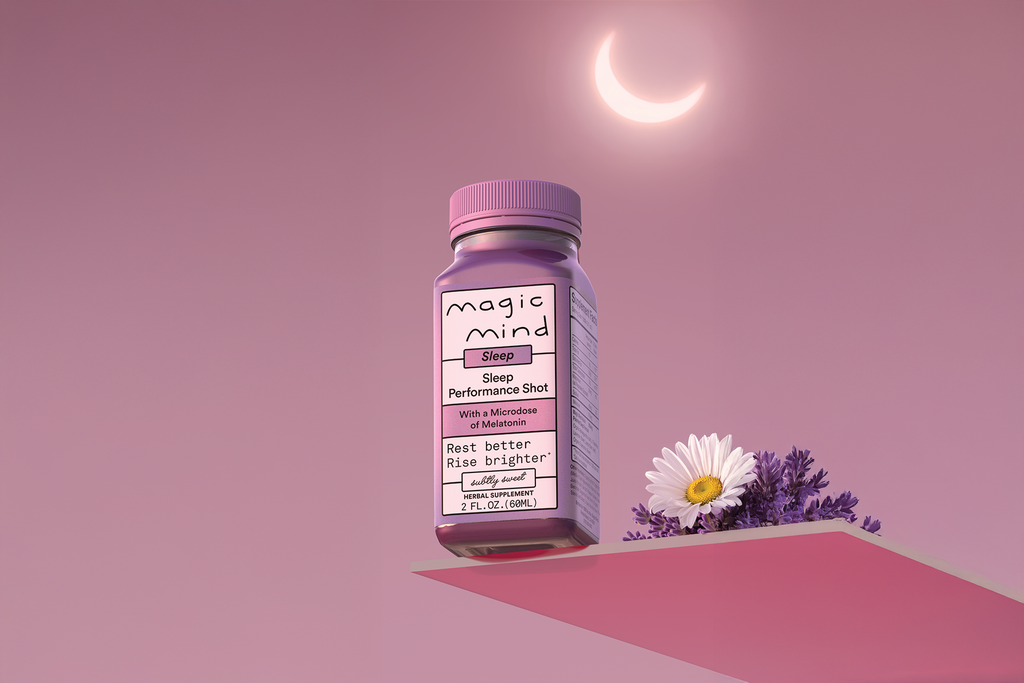
On any overnight or long-haul flight, the goal during the bulk of your flight time is restorative sleep. Magic Mind Sleep is a 2oz sleep performance shot formulated specifically for this; with Microdosed Melatonin, L-Theanine, and Magnesium Glycinate. Take it when the cabin lights go down.
Microdosed Melatonin works with your circadian system rather than overwhelming it; too high a dose causes grogginess and can actually interfere with your rhythm, which is why dosage precision matters. L-Theanine supports calm without sedation, lowering mental noise so you can transition into sleep. Magnesium Glycinate supports muscle relaxation and nervous system recovery, both of which are suppressed during the stress and tension of travel. Together, they're not a sedative, they're a sleep quality system.
The Landing Window
About 30 to 60 minutes before landing, it's time to shift gears. Magic Mind Original, taken pre-landing, gives you a cognitive runway that's active by the time you touch down. The 55mg of natural caffeine is paired with L-Theanine to eliminate the jittery edge and provide smooth, sustained energy. The adaptogens and nootropics in the formula are doing the deeper work on focus and stress resilience so that when you step off the plane, your brain is already in performance mode, not catch-up mode.
A note on absorption: Both shots use a nanoencapsulated liquid formula, which delivers ingredients significantly more efficiently than pills or powders. This matters particularly during travel, when digestion is slower and less reliable due to altitude, dehydration, and disrupted eating schedules. The liquid format bypasses much of that digestive friction and gets to work faster.
Can you bring Magic Mind in your carry-on?
Yes. Both shots are 2oz, which is fully compliant with TSA's 3-1-1 liquids rule (containers must be 3.4oz/100ml or less). Pack them in your quart-size liquids bag alongside your other travel-size items and you're cleared for any domestic or international flight.

On the Ground: The Cognitive Challenges Don't Stop at Baggage Claim
Here's the part that doesn't get talked about enough: the mental demands of travel don't end when you land. In many ways, they intensify.
Jet Lag Goes Deeper Than Tiredness
Research on jet lag consistently shows that its effects extend well beyond feeling sleepy. In the days following a significant time zone cross, travelers experience measurably impaired executive function; the higher-order thinking involved in planning, decision-making, and problem solving. Reaction time slows. Emotional regulation becomes harder. Memory consolidation is disrupted, meaning you're less likely to retain what you learn or experience in the first days at your destination.
For business travelers, this isn't an inconvenience. Presenting to clients, sitting in negotiations, or running meetings within hours of a long-haul flight is asking your brain to perform at a serious disadvantage.
The New Environment Tax
Even when travel is purely recreational, your brain is working harder than it does at home. New navigation, unfamiliar food, different schedules, and a foreign language or cultural context all require your prefrontal cortex to stay active in ways it doesn't when you're in your familiar environment. There's no autopilot. Every decision has to be made consciously. That's cognitively expensive, even when it's enjoyable.
The Role of Consistency
One of the most powerful things you can do for mental performance during travel is maintain your existing routines wherever possible. The brain relies on predictable habits as cognitive shortcuts; when everything else is unpredictable, your habits act as anchors. Taking Magic Mind Original at the same time each day, even in a hotel room in a different time zone, keeps one consistent signal in your brain's daily schedule. Adaptogens like Ashwagandha and Lion's Mane are particularly relevant here: they support the brain's stress response over time, and their benefits compound with consistent use.
Night One at Your Destination
The first night's sleep at your destination is disproportionately important. It sets the tone for how quickly your circadian system re-anchors. Magic Mind Sleep, taken before bed at local time, supports that adjustment through its microdosed Melatonin, signaling to your body that it's time to sleep according to the new clock, not the one you left behind.

Ingredient Spotlight: What's Working for Travelers
The effectiveness of any supplement comes down to what's in it and whether the dosages are meaningful. Here's a closer look at the key ingredients in Magic Mind's travel protocol and why each one matters specifically in the context of travel stress.
Lion's Mane is a medicinal mushroom with a growing body of research supporting its role in neuroplasticity, the brain's ability to adapt and form new connections. During travel, when your brain is under environmental stress and cognitive load, Lion's Mane supports the cognitive flexibility you need to keep performing rather than shutting down.
Ashwagandha is one of the most extensively studied adaptogens in clinical literature. Multiple trials have demonstrated its ability to reduce serum cortisol and subjective stress. Travel reliably spikes cortisol; the disruption, the unpredictability, the sleep disruption all activate your stress axis. Ashwagandha helps blunt that response, so it doesn't compound into multi-day burnout.
L-Theanine is an amino acid found naturally in green tea that promotes what researchers describe as "alert calmness," calm without sedation, focus without anxiety. Paired with caffeine, it smooths the energy curve and eliminates the jitteriness that can make stimulants counterproductive in already high-stress environments like airports and early-morning meetings.
Magnesium Glycinate is a highly bioavailable form of magnesium that supports both muscle relaxation and sleep quality. Magnesium is commonly depleted during periods of stress, and the glycinate form is specifically associated with nervous system calming, particularly relevant for anyone whose body is still holding the tension of a long travel day.
Microdosed Melatonin is the key to Magic Mind Sleep's approach to sleep support during travel. The research on melatonin is nuanced: high doses (the 5–10mg commonly sold over-the-counter) can cause next-day grogginess and may actually suppress your natural melatonin production over time. Microdosed Melatonin, at a fraction of that amount, works with your body's own system to signal sleep timing, supporting circadian adjustment without the downsides of larger doses.
Rhodiola Rosea is an adaptogen with clinical evidence for reducing both mental and physical fatigue under stress. It's particularly relevant during travel because it supports endurance of mental effort, the ability to keep thinking clearly when your body is tired and your environment keeps changing.
Turmeric (as Curcumin) plays an anti-inflammatory role in the formula. Sleep deprivation and long-haul travel both elevate systemic inflammatory markers. Chronic low-grade inflammation is increasingly understood as a driver of cognitive fatigue and brain fog. Turmeric supports the reduction of that inflammatory response, contributing to clearer thinking over the course of a trip.

Frequently Asked Questions
Can I bring Magic Mind in my carry-on?
Yes. Magic Mind shots are 2oz, which puts them well under the TSA's 3-1-1 limit of 3.4oz (100ml) per container. Pack them in your quart-size liquids bag with your other travel-size items. They're cleared for domestic and international flights.
How many should I pack for a trip?
A practical rule: one Magic Mind Original per day of your trip, plus one Magic Mind Sleep per overnight flight or night where you anticipate difficult sleep; first night at a new destination, red-eye flights, or any night you're crossing more than a few time zones.
When exactly should I take each shot on a flight?
Take Magic Mind Sleep when the cabin lights go down and you're settling in for rest. Take Magic Mind Original approximately 30 to 60 minutes before your scheduled landing time so that it's active by the time you deplane.
Does Magic Mind help with jet lag specifically?
Magic Mind Sleep's Microdosed Melatonin directly supports circadian resynchronization, which is the underlying mechanism of jet lag. It works best as part of a broader approach; also try to get natural light exposure at your destination during local daylight hours and keep meals on local time from day one. Consistency with Magic Mind Original also helps stabilize cognitive performance while your body adjusts.
What if I'm only taking a short trip and can't build a real routine?
Even single-use, both shots deliver acute performance support. You'll still feel the difference on a one-day trip. That said, the adaptogens and nootropics in Magic Mind Original, like Ashwagandha and Lion's Mane, do produce more pronounced effects with consistent daily use over time, so the daily habit pays off in ways a single dose can't fully replicate.
Can I take Magic Mind if I'm sensitive to caffeine?
Magic Mind Original contains 55mg of natural caffeine, roughly half a cup of coffee, paired with L-Theanine, which is specifically included to moderate the stimulant response and prevent jitteriness. If you're particularly sensitive to caffeine, Magic Mind FREE contains no caffeine but delivers the same full cognitive support stack.
Should I avoid alcohol if I'm taking Magic Mind on a flight?
Yes, it's best not to combine Magic Mind with alcohol. If you plan on having a drink during a flight, time your Magic Mind shots separately: take your Sleep shot well before or after any alcohol and use your Original shot as a pre-landing protocol rather than an in-flight one if you're drinking.
Your Complete Travel Performance Stack
Here's the full protocol, laid out simply:
The night before you travel, prioritize sleep above everything else. If pre-trip adrenaline or anxiety is keeping you up, Magic Mind Sleep can help you wind down and get the restorative rest that sets your baseline for the next day.
On travel day morning, take Magic Mind Original with breakfast before you head to the airport. This gets your cognitive support active before the decision fatigue and cortisol of the airport experience begin.
On any long-haul or overnight flight, take Magic Mind Sleep when the cabin dims. Let it support deeper, more restorative in-flight rest.
About 30 to 60 minutes before landing, take Magic Mind Original. Arrive with your brain already in gear.
On your first full day at your destination, maintain your Magic Mind Original habit at your normal daily time. Consistency is the signal that tells your brain the routine is intact, even when the environment isn't.
On the first night at your destination, take Magic Mind Sleep at local bedtime to help anchor your circadian rhythm to the new time zone.
The Bottom Line
Travel has always asked a lot of the human body. What's changed is our understanding of what it's actually asking and our ability to address it with precision rather than guesswork.
The goal isn't to white-knuckle through a red-eye and hope you're functional by Tuesday. It's to treat mental performance as a system, give it the inputs it needs at the right times, and arrive, wherever you're going, genuinely ready to be there.
That's the protocol. That's what we built Magic Mind for.

Try Magic Mind before your next trip at magicmind.com. Magic Mind Original, Magic Mind FREE, Magic Mind MAXX, and Magic Mind Sleep are available now.
Magic Mind is also available onboard Fiji Airways Business Class on select long-haul routes as part of the FlyWell programme, beginning June 1, 2026. Learn more at fijiairways.com/flywell.
Daily habit. Lifelong benefits.